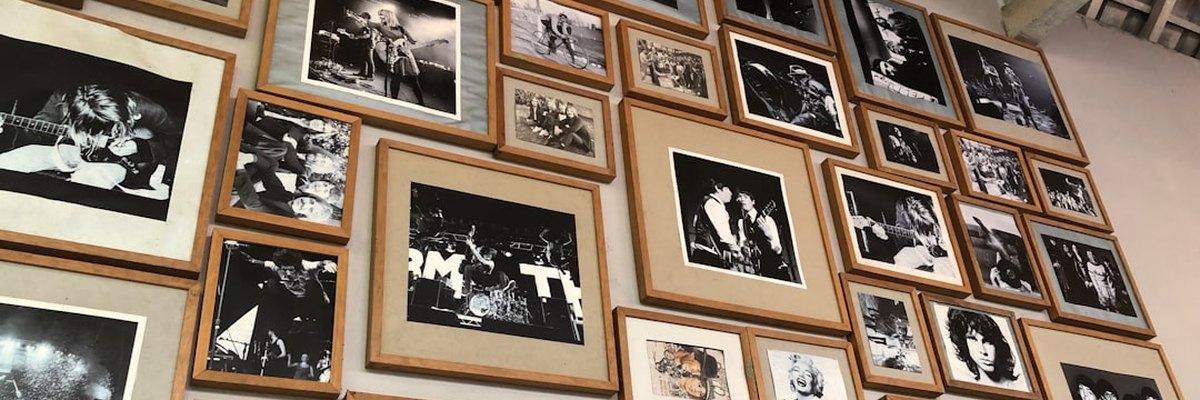
Do vision boards actually work? The honest, research-backed answer is: not in the way most people build them — and in some of the best studies on this, picturing your desired future too vividly left people less likely to actually get there. That's an uncomfortable thing to learn midway through building a feature for Kansha that, if you squint, looks exactly like a vision board: a canvas where you drag pictures around and arrange them however you like. I built it anyway. I just built it on the opposite psychological principle to the one vision boards run on, and that difference is the whole point of this post.
Do vision boards actually work?
The psychologist who's done the most rigorous work on this is Gabriele Oettingen, and her findings are not what the vision-board industry wants you to hear. Across two decades of studies, Oettingen found that what she calls "indulging" — vividly picturing a desired future while leaving the obstacles out of the picture entirely, which is essentially the instruction behind every vision board — doesn't just fail to help. It can actively undermine follow-through. In one of her studies, women in a weight-loss programme who fantasised most vividly about reaching their target weight lost less over the following months than the women who pictured the challenge more realistically. She found similar patterns with job seekers, students, and people rehearsing how a difficult conversation would go. The theory is that a vivid fantasy gives your brain a small taste of already having the outcome — and that taste of premature completion is precisely what saps the motivation to do the work that would make it real.
Her proposed fix isn't "stop imagining the future" — it's to pair the fantasy with the obstacle. She calls it mental contrasting, packaged into a technique called WOOP (Wish, Outcome, Obstacle, Plan): picture the win, then immediately picture the specific thing standing between you and it, then plan around that obstacle. Picturing the outcome alone, the way a vision board asks you to, is the part that backfires.
So why does Kansha have a feature that looks exactly like one?
Around the same time I was reading Oettingen's work, I was building a feature inside Kansha called Life Map — a canvas where you search for images, drag them around, resize them, and arrange them like a scrapbook. On a screen recording it looks identical to a vision board. I actually left myself a note in the build brief before writing the first line of it, because I could already see the confusion coming: this is not a vision board. It's a present-tense map of what matters — not a board of what you want, but a board of what's already true.
That distinction sounds like marketing spin until you look at what's actually meant to go on the canvas. A vision board is built from things you don't have yet — the house, the body, the relationship, the number in the account. Life Map starts with an empty canvas and one instruction: add an image that represents something good in your life right now. Not the life you're hoping for. The one you're already living.
What's actually different between a vision board and a gratitude map?
This is where the psychology genuinely splits, not just the branding. A vision board asks you to fantasise about an outcome you don't have — that's the exact mechanism Oettingen studied, and it's a future-tense act of wanting. Life Map asks you to notice and represent something you already have, which lands in a completely different, and much better supported, body of research: savoring.
Psychologists Fred Bryant and Joseph Veroff spent years studying the difference between simply experiencing something positive and deliberately attending to and appreciating it while it's happening or shortly after — they call the second one savoring. Their consistent finding is that people who make a habit of savoring — actively noticing and extending good experiences rather than letting them slide past — report meaningfully higher life satisfaction than people with similar amounts of good happening to them who never pause to register it. Gratitude journalling is essentially savoring through writing. Life Map is the same underlying act through pictures instead — you're not conjuring a future, you're slowing down on a present you'd otherwise scroll straight past.
That's the honest one-line difference: a vision board is future-tense wanting, and it carries Oettingen's demotivation risk. A gratitude map is present-tense noticing, and it carries savoring's smaller, but real, wellbeing benefit. Same medium — pictures on a board — pointing in opposite psychological directions.
Why use pictures at all — why not just keep writing?
Because there's an old, well-replicated finding in memory research called the picture superiority effect: across dozens of studies, people remember images better, and for longer, than they remember equivalent words. The classic explanation, Allan Paivio's dual coding theory, argued that a picture gets encoded twice — once as a visual trace, once as whatever word you'd use to describe it — while a word only gets encoded once, giving pictures a structural memory advantage.
I'll be straight about the current state of that explanation, because I try not to launder shaky science into a feature description: a 2024 paper by Higdon, Neath, Surprenant and Ensor argues dual coding isn't actually what's doing the work, and that plain distinctiveness — pictures simply looking more different from each other than words do — explains the effect just as well or better. The two camps disagree about why it happens. Nobody serious disagrees that it does happen. Pictures stick in a way text doesn't, for reasons still being argued over in journals I've no ability to referee.
One more honesty flag, because it matters for what Life Map actually is: the images aren't your own photos, they're pulled from a stock image search. You're not storing a photograph of the actual moment — you're finding a symbol for it. Searching "steam" because you were thinking about how your coffee looked one particular morning isn't the same as a photo of that coffee. It's closer to a visual metaphor than a memory. I still think it's worth doing — a symbol you chose on purpose is a stronger retrieval cue than nothing — but it's a smaller, more honest claim than "picture superiority effect, therefore your gratitude practice is now scientifically optimised," and I'd rather say that plainly than let a citation do more work than it's earned.
How I actually use mine
Mine isn't full, and I should say that plainly, because most of what I write about here is stuff I use daily, and Life Map is the Kansha feature I visit least — maybe once every couple of weeks, usually rearranging rather than adding. What's on it: a search for the specific grey-green a stretch of coastline near me turns whenever the weather's bad, because that colour turns up in my journal entries more than almost anything else I write about. A search for "kitchen window", because a disproportionate number of my actual good moments happen standing at mine with a coffee before anyone else in the house is up. One that's harder to explain quickly — a fairly abstract image I found searching "leaving", from the stretch of time I spent deciding whether to walk away from client consulting work and build Kansha properly. It doesn't depict anything literal about that decision. It's just become the thing my eye lands on that pulls the whole period back.
The physical act of using it — dragging an image somewhere else, resizing it, deciding it belongs in the corner instead of the middle — is a small, fiddly, almost tactile task, and the fiddling is where my attention actually sits on the thing for a few extra seconds. If I'm honest, that's probably the real mechanism at work here, more than anything grand about pictures versus words: rearranging something forces you to look at it again.
Does this replace the vision board on your wall, or the words in your journal?
No, to both, and I don't think it should try to. If you already keep a proper vision board — the kind paired with a concrete plan and an honest list of what's in your way, which is the Oettingen-approved version — that's a legitimate goal-setting tool doing a completely different job to gratitude practice, and I've nothing to add to it. Life Map isn't trying to replace that, because it isn't about goals at all.
It's also not trying to replace writing. It sits alongside the journal, not instead of it — the same way the Jar and the Five Fs review sit alongside it, each a different retrieval cue into the same underlying habit of paying attention to your own life. Some weeks the words come easily and the pictures stay untouched. Some weeks I can't find the sentence, but I know exactly which image I'd add.
Where can this go wrong?
The obvious failure mode is the one I built the whole feature to avoid, and it's easy to slide back into anyway: turning the board into an aesthetic performance rather than something true. Stock image search makes it very easy to pick the prettiest result instead of the accurate one — a beautifully lit photo of "coffee" instead of the slightly ugly, specific thing that's actually true for you. The moment you're curating for how the board looks rather than what it represents, you've quietly rebuilt a vision board — an aspirational display rather than a present-tense one — just with better lighting.
The other failure mode is simpler: an empty canvas does nothing. Same as the jar, same as any feature in this app that depends on you actually using it — Life Map only works retroactively, on attention you've already paid. It can't manufacture a good life to represent. It can only help you notice the one you've already got.
If you want to try it honestly, the instruction I'd give is the same one already sitting in the empty state of the feature itself: search for one thing that's already true, not something you wish were. Not the version of your life you're hoping arrives. The one you're standing in right now.